Featured in Johns Hopkins Engineering: In the world of AI, who speaks for the trees?
I study AI systems to make them more human-like - 3D, efficient, robust, and learning continually.
My research combines analysis by synthesis, part-centric 3D semantics, and update-geometry theory to build models that are interpretable, data-efficient, and robust under continual shift.
My expertise spans from cognitive science to 3D vision and machine learning, including causal reasoning, physics of AI and continual learning.
On the 2026 faculty market (postdoc, assistant professor) and research scientist (industry) market
- Computer Vision
- 3D Semantics
- Mechanistic ML
- Continual Learning
At a Glance
- Current: PhD candidate at Johns Hopkins University
- Program: Structured perception, compositional 3D world modeling, and continual adaptation
- Flagship papers: Universal Weight Subspace Hypothesis and Name That Part
- Next step: Building an independent research group starting in 2026
- Human-like perception and diagnostics
- 3D parts, semantics, and world modeling
- Analysis-by-synthesis for reasoning
- Efficient and strict continual learning
News
Co-first-authored paper accepted to the International Conference on Computer Vision (ICCV 2025).
Gaussian Scenes was accepted to Transactions on Machine Learning Research (TMLR).
Two papers accepted as oral presentations at CVPR Workshops 2025.
EigenLoRAx is now available. Try it out for efficient and sustainable learning of large models.
Our work on Sparse View 3D reconstruction is now available. Check out Gaussian Scenes.
Featured Work
Core papers that define a coherent long-term agenda across theory, 3D semantics, and continual learning.
Program-Defining Theory
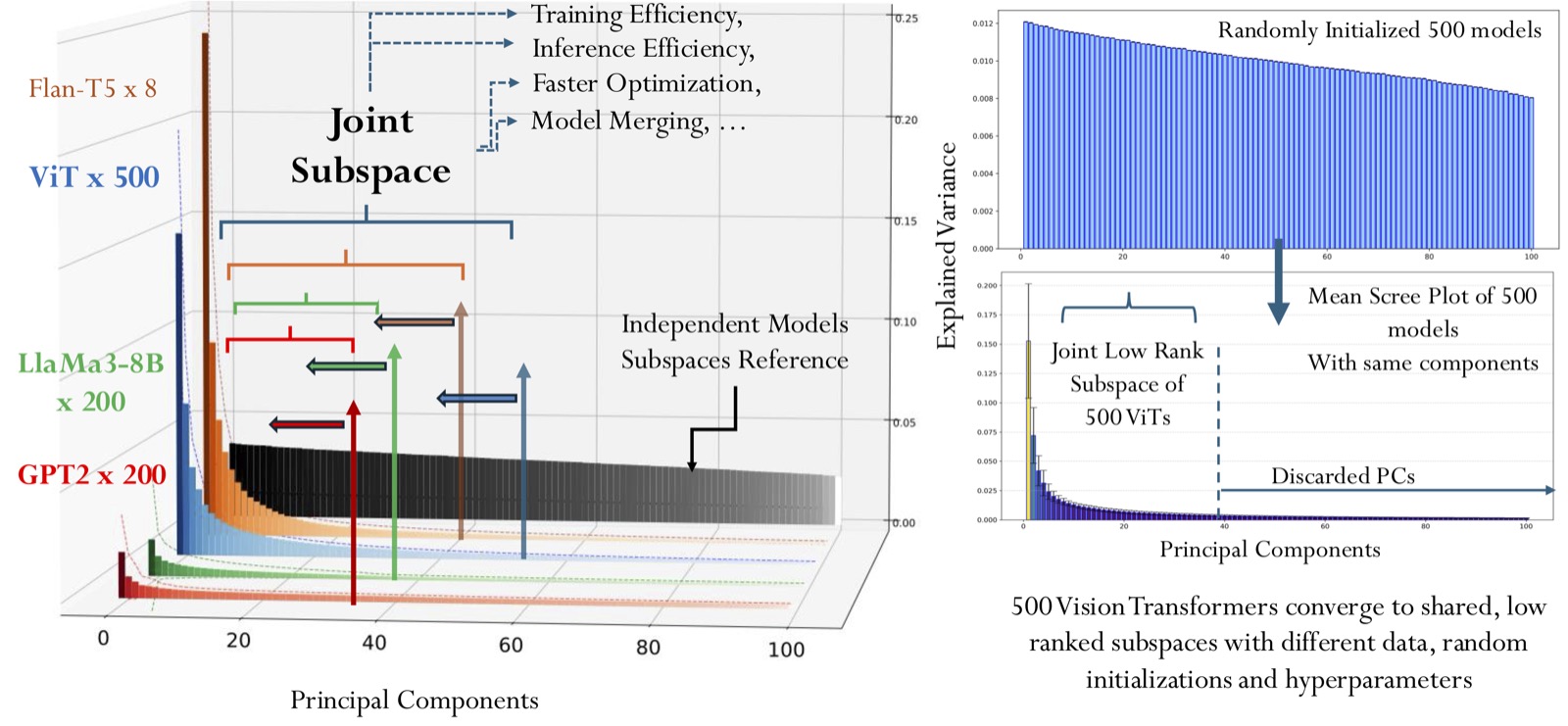
The Universal Weight Subspace Hypothesis
Problem: Modern neural models are difficult to interpret and expensive to adapt repeatedly.
Key idea: Learned updates across tasks and domains concentrate in shared low-dimensional subspaces.
Why it matters: This unifies parameter-efficient tuning, model merging, and continual learning under a single geometric mechanism.
Program-Defining System
Name That Part
A scalable system for jointly segmenting and semantically naming 3D object parts.
Problem: 3D systems often separate geometric part segmentation from semantic naming.
Key idea: Formulate part segmentation and naming as set alignment with permutation-consistent inference and scalable human-in-the-loop annotation.
Why it matters: It establishes a reusable semantic foundation for part-level perception, data creation, and downstream 3D reasoning.
Shared LoRA Subspaces for Almost Strict Continual Learning
Reuses a shared LoRA subspace to balance adaptation and retention over continual updates.
Problem: Continual updates in large models often trade off adaptation quality against forgetting.
Key idea: Reuse a shared LoRA subspace to preserve prior capabilities while learning new tasks.
Why it matters: Moves toward almost strict continual learning without full retraining overhead.
Perceptual Taxonomy
A structured diagnostic for where vision-language perception breaks.
Problem: Vision-language models succeed at recognition but fail at structured perceptual reasoning.
Key idea: A cognitively grounded taxonomy and evaluation that probes how models reason.
Why it matters: It guides structure-based perception models and interpretability diagnostics.
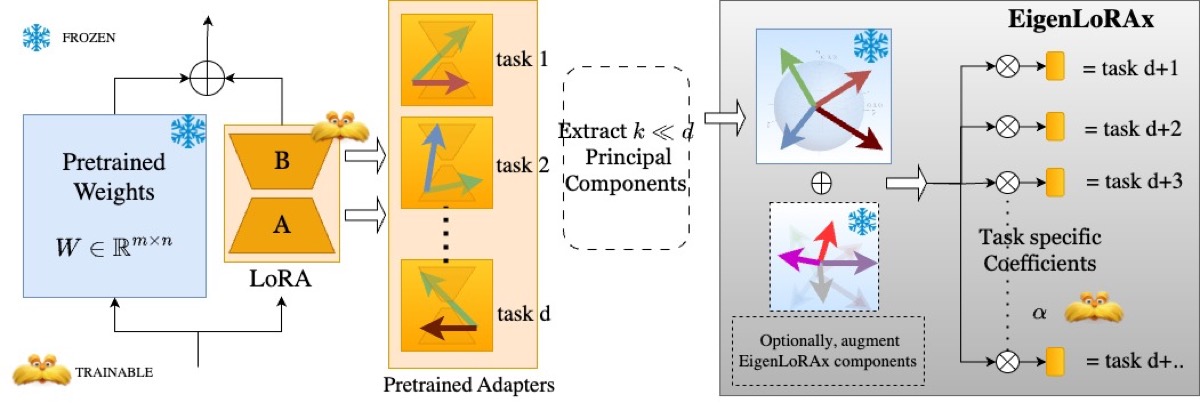
EigenLoRAx
Recycles prior adapters into principal subspaces for fast, efficient adaptation.
Problem: Adapter-based fine-tuning is efficient but its gains are often siloed.
Key idea: Recycle adapters to estimate principal subspaces for fast reuse and merging.
Why it matters: It accelerates adaptation while keeping continual updates lightweight.
External Visibility
Recent work has appeared in institutional coverage and community discussions.
View selected press and external coverage or browse the full publication list on Google Scholar.