Single Shared Subspace
A shared low-rank basis is updated as new tasks arrive, keeping a compact representation of useful adaptation directions.
Accepted to ECCV 2026
Share learns a single shared low-rank subspace that grows with new tasks while keeping continual adaptation compact and stable.
Based on the Universal Weight Subspace Hypothesis.
Share focuses on parameter-efficient continual finetuning without data replay or a growing library of task-specific adapters.
A shared low-rank basis is updated as new tasks arrive, keeping a compact representation of useful adaptation directions.
New task directions are integrated while minimizing interference with prior tasks, reducing catastrophic forgetting.
Many task-specific adapters are replaced by one evolving subspace, reducing parameter and memory overhead across modalities.
A compact flow for updating knowledge over time.
Start with a low-rank basis that captures core task knowledge.
Find essential directions needed for each incoming task.
Merge the new directions into the shared subspace for reuse.
Key visuals from the paper.
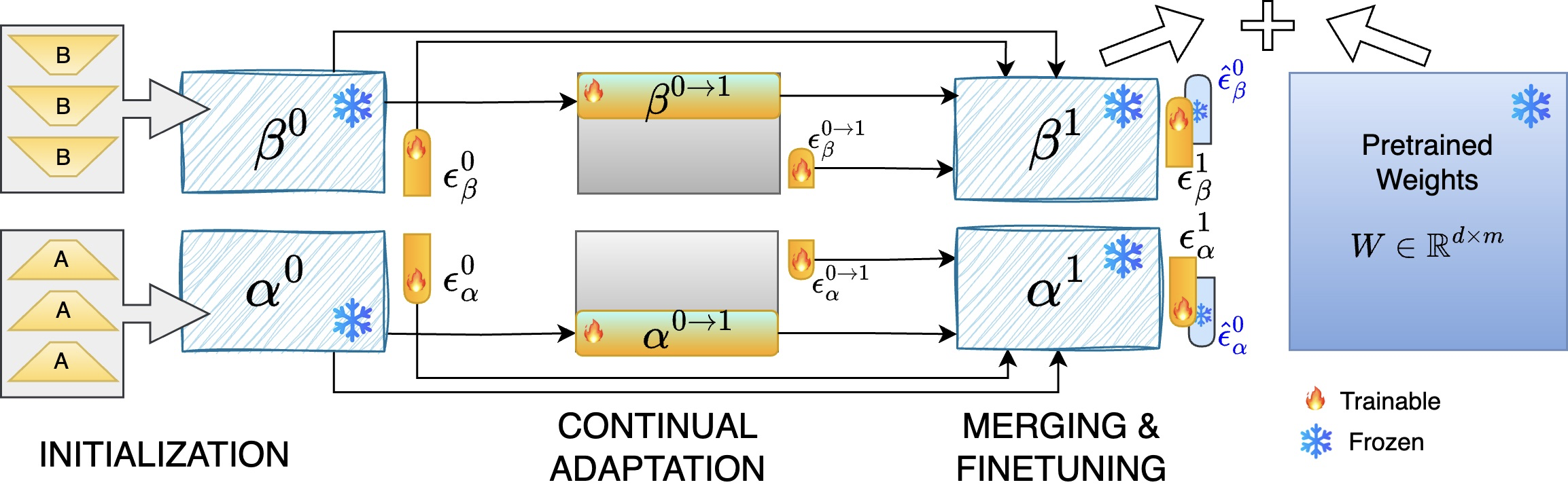 Open method figure
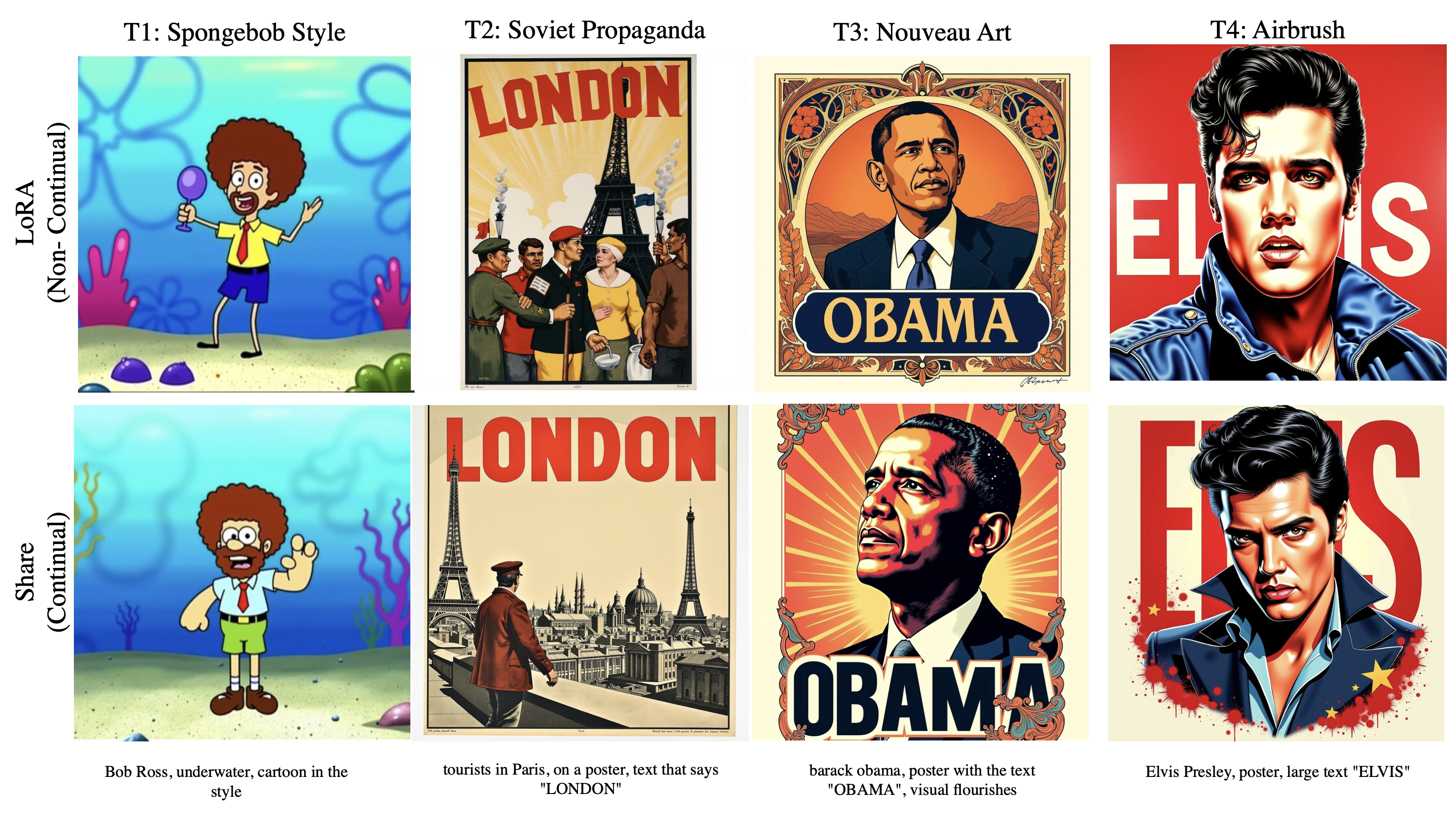 Open results figure
Reported gains span vision, language, 3D pose, and text-to-image tasks.
Up to 100x parameter reduction and 281x memory savings compared to traditional LoRA approaches, while maintaining performance close to jointly trained models.
A single Share model can replace many task-specific adapters, supporting continual learning without maintaining separate LoRA weights per task.
Use this entry to cite the paper.
Preview the PDF or open it in a new tab.